About The Book
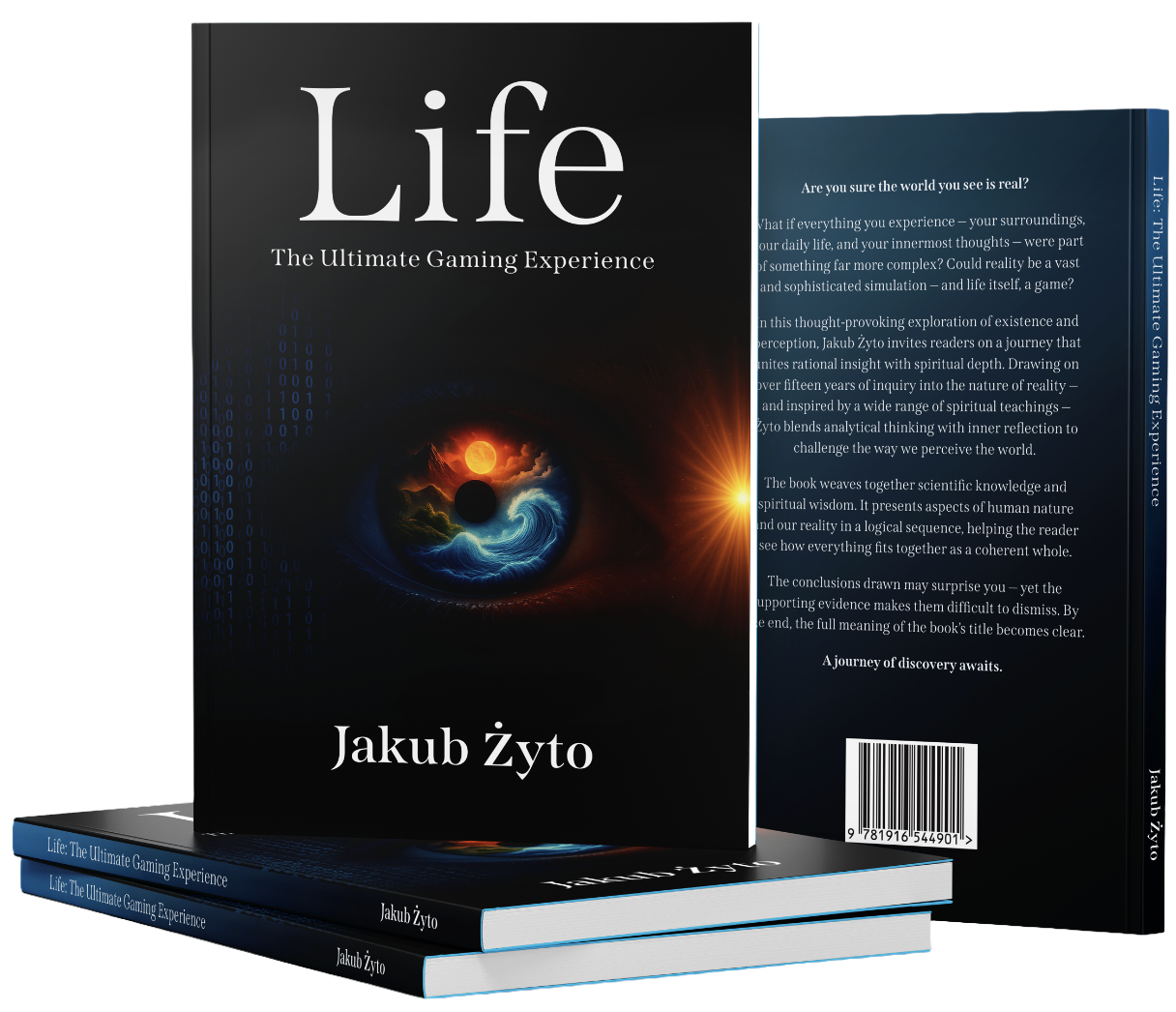
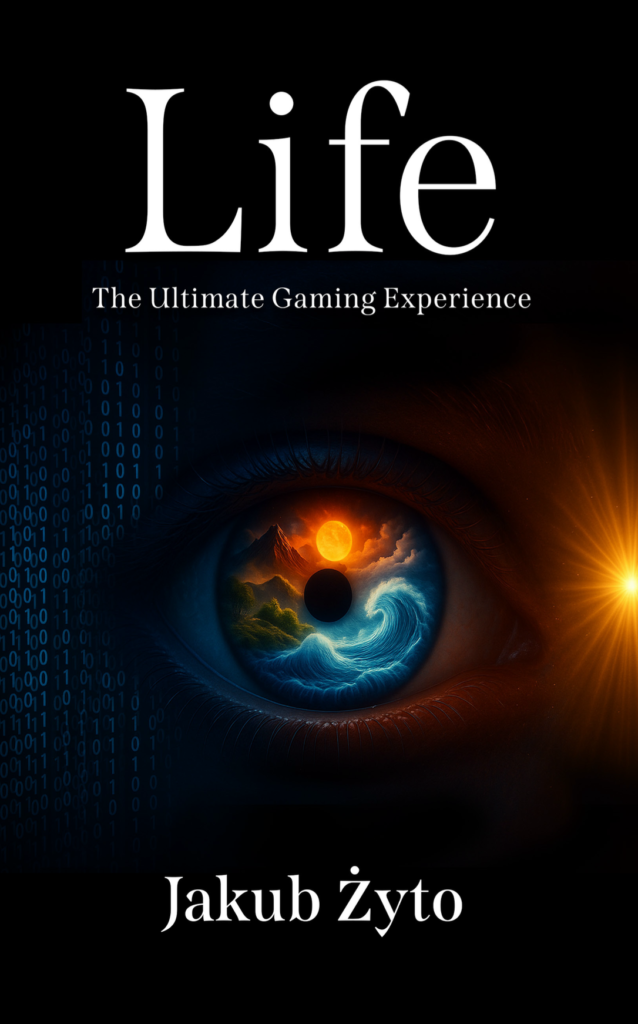
Are you sure the world you see is real? What if everything you experience—your surroundings, daily life, even your innermost thoughts—were part of something far more complex? Could reality be a vast simulation, and life itself, a game?
In Life: The Ultimate Gaming Experience, Jakub Żyto invites readers on a journey that unites rational insight with spiritual depth. Drawing on a wide range of scientific and spiritual perspectives, he blends analytical thinking with inner reflection to challenge the way we perceive the world.
The book weaves together scientific knowledge and spiritual wisdom, presenting aspects of human nature and reality in a logical sequence so readers can see how everything fits together. Its thought-provoking conclusions may surprise you—yet the supporting evidence makes them difficult to dismiss. By the end, the full meaning of the title becomes clear.
What Readers Say
I’d love to hear your thoughts! Share your feedback or first impressions by emailing me at
info@jakubzyto.com
Mariusz
..I found it (‘Life: The Ultimate Gaming Experience’) intriguing, thought-provoking and approachable. If you enjoy questioning reality and exploring deeper topics without being overwhelmed or preached to, this book is definitely worth reading and rereading..
Mariusz
Agnieszka Siekierska
I truly recommend this book (‘Life: The Ultimate Gaming Experience’). It is thought-provoking and offering insight that stays with you long after you finish reading. I enjoyed the ideas and the way they made me think. The book it a great choice for every reader, whether you’re new to the topic or already familiar with it. Highly recommended..
Agnieszka Siekierska
Dr Tiziana Soverino
Drawing upon subjects as diverse as computer science, psychology, mathematics and archaeology, this thought-provoking book delves into the ways human perception and thoughts can shape reality. A must-read for those who want to explore the topics covered by The Matrix and The Secret.
Dr Tiziana Soverino
Dr Sarah Meehan O’Callaghan
Walking a fine line between science and spirituality, materialism and metaphysics, Jakub Żyto’s provocative and erudite enquiry challenges us to consider whether the very fabric of our reality may not be as it seems and whether, indeed, our future is dependent on the rules of a game.
Dr Sarah Meehan O'Callaghan
Jakub’s Reflections
Is Reality Written in Code?
Intro:
When we examine the structure of the world more closely, a striking pattern emerges. Across science and nature, reality appears to follow precise rules—expressed through numbers, constants, and relationships. This naturally raises a deeper question: could the world itself operate in a way similar to a form of code?
Reflection:
The sciences describe reality using mathematical language. In chemistry, elements combine only in specific ways. In physics, fundamental constants define what is possible and what is not. In this sense, the world behaves as though it were governed by a set of underlying rules.
One of the most compelling examples of structured information in nature is DNA. Encoded within its molecular sequence is an instruction set that governs the production of proteins—determining where, when, and in what quantity they are formed. Proteins, in turn, constitute the primary building blocks and functional mechanisms of the human body.
This process resembles the logic found in computer programming. At its most fundamental level, computer programming is built on simple conditional logic—instructions that follow a basic pattern: if a certain condition is met, then a specific outcome occurs.
A simple illustration of this principle appears in classical physics. Newton’s third law states that every action is accompanied by a reaction—a direct relationship between cause and effect.
Whether one interprets this order as design, structure, or simply the nature of reality itself, one thing becomes clear: the world does not operate randomly. It unfolds through consistency—an order expressed through numbers, relationships, and deeply reliable rules.
The World as a System of Cycles
Intro:
When we step back from individual events and observe reality as a whole, another pattern becomes visible. Life does not unfold in straight lines, but in repeating rhythms. Everything seems to move in cycles.
Reflection:
The world we experience operates through interconnected cycles. Much like the mechanism of an old mechanical clock, larger gears set smaller ones in motion. No element functions in isolation—every movement influences another.
From our perspective on the surface of the world, existence reveals itself through recurring rhythms. Day follows night. Activity gives way to rest. Growth is followed by decline, only to begin again. These cycles are not separate phenomena but components of one coherent
system.
The Sun plays a central role in shaping these rhythms. Its daily presence defines the cycle of light and darkness, while its changing position in the sky throughout the year influences temperature, daylight length, and seasonal transformation. These observable changes regulate life—from the growth of plants to periods of dormancy.
Each rhythm sets the conditions for another. Environmental cycles influence biological ones, which in turn affect behaviour, energy levels, and internal processes within the human body. Like interlocking gears, the motion of one cycle sustains the movement of others.Viewed this way, reality appears less chaotic and more coherent—not static, but shaped by continuous movement and repetition.

Jakub Żyto
Author
Jakub Żyto is a nonfiction author based in Ireland, originally from Poland. With a Master of Science in Chemistry from Łódź University of Technology and decades of experience in scientific research and industry, he brings a disciplined, analytical perspective to his exploration of big questions.
His writing delves into the origin of the world, ancient history, spirituality, and human experience. Life: The Ultimate Gaming Experience, his debut book, reflects his ongoing curiosity about where we come from, the purpose of life, and where we are headed.
Outside of writing, Jakub enjoys hiking, cycling, reading, video games, and engaging in philosophical discussion.
For questions, feedback, or
media enquiries, please contact me at:
info@jakubzyto.com
© 2026, Jakub Żyto. All rights reserved.